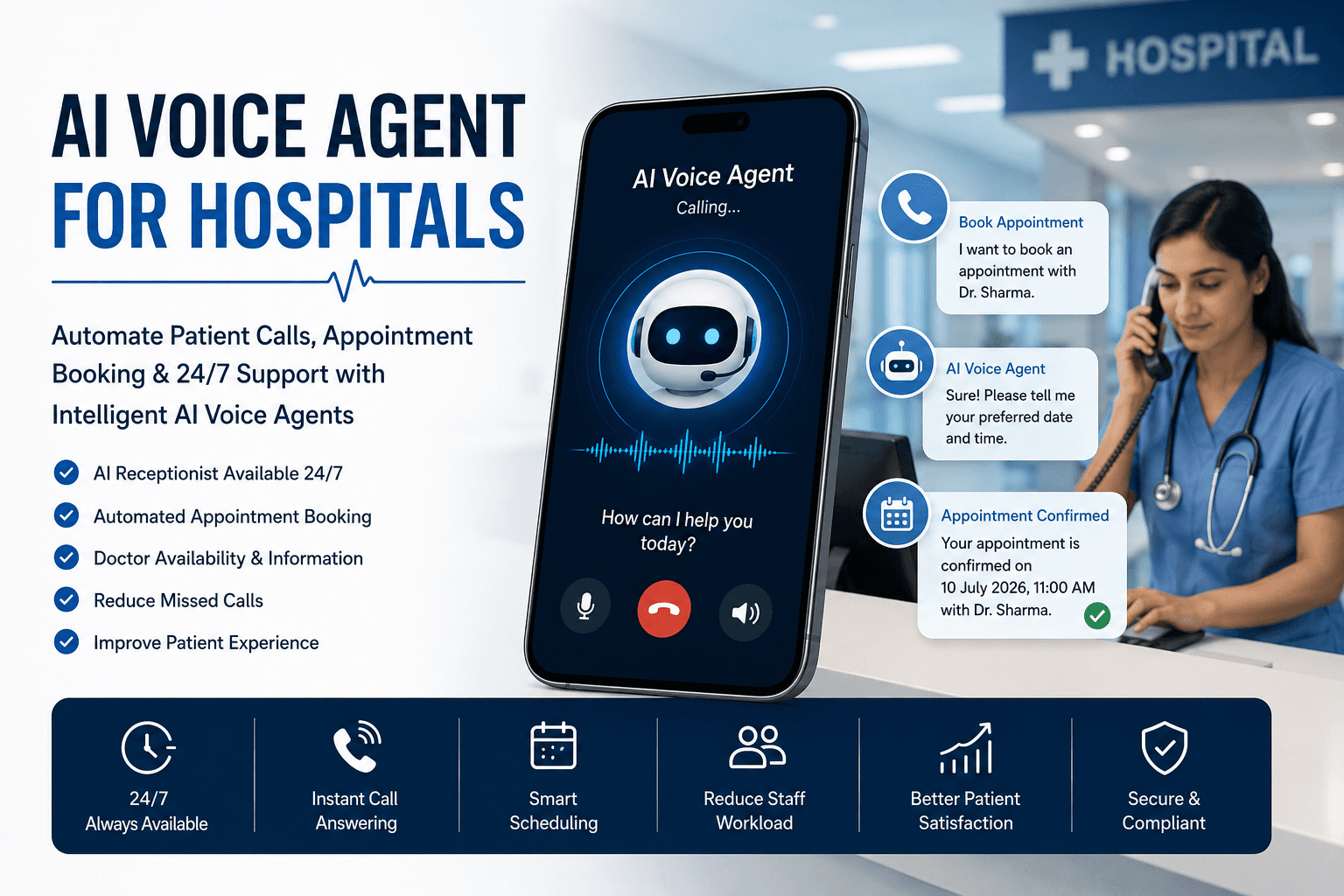
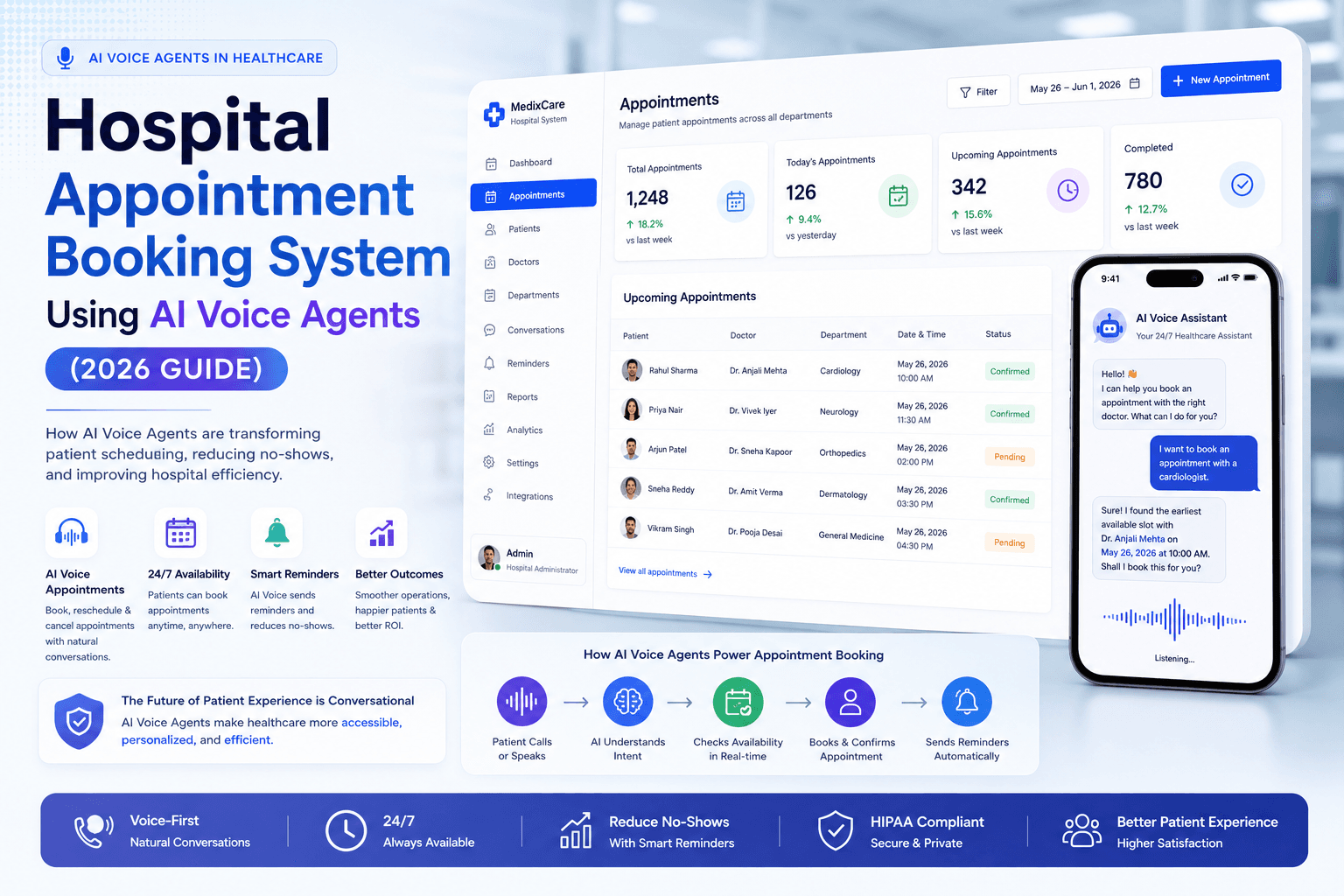
Hospitals receive hundreds of patient calls every day for appointment booking, doctor availability, cancellations, follow-ups, and general inquiries. AI voice agents automate these conversations using advanced speech recognition, natural language understanding, and realistic voice synthesis. This guide explains how AI hospital receptionists work, their architecture, business benefits, implementation process, and why healthcare organizations are rapidly adopting AI-powered communication systems.
Learn how AI voice agents are transforming hospitals by automating patient calls, appointment scheduling, doctor availability checks, and healthcare communication while reducing operational costs and improving patient satisfaction.
Introduction
Every hospital depends on effective communication with patients. Whether someone wants to book an appointment, confirm a consultation, check doctor availability, or ask about hospital services, every incoming call is an opportunity to provide quality care. Unfortunately, busy reception desks, limited staff, and high call volumes often lead to missed calls, long hold times, and delayed responses that frustrate patients who may already be anxious or in discomfort.
Front desk teams are frequently pulled in multiple directions — greeting walk-in patients, verifying insurance, managing paperwork, and answering phones — all at the same time. When call volume spikes, something has to give, and too often it's the phone. A missed call from a patient trying to book a same-day appointment can mean that patient goes elsewhere, or worse, delays care they actually need.
AI Voice Agents solve this challenge by acting as intelligent virtual receptionists. They answer every patient call instantly, understand natural conversations, schedule appointments automatically, answer frequently asked questions, and integrate directly with hospital management systems. Hospitals can improve patient experience while reducing operational costs and staff workload, freeing up human receptionists to focus on patients who are physically present and need in-person assistance.
What is an AI Voice Agent for Hospitals?
An AI Voice Agent is an artificial intelligence-powered receptionist capable of having natural conversations with patients over phone calls. Unlike traditional IVR systems that require patients to press multiple buttons and navigate rigid menu trees, AI voice agents understand spoken language, maintain conversation context, and perform real business tasks — the same way a trained human receptionist would.
Patients can simply speak naturally, and the AI understands their request, checks appointment availability, books consultations, answers questions, or transfers calls to the appropriate department when necessary. There's no need to remember which number corresponds to "billing" or "new appointments" — the patient just says what they need, and the system figures out the rest.
This shift matters more than it might initially seem. Traditional phone trees create friction precisely when patients are least equipped to deal with it — when they're unwell, stressed, or unfamiliar with the hospital's internal structure. A conversational AI system removes that friction entirely, letting the patient lead with plain language while the system handles the routing and logic behind the scenes.
How AI Hospital Voice Agents Work
Modern AI receptionists combine multiple technologies that work together in real time to create natural conversations between patients and hospitals. Understanding this pipeline helps hospital administrators evaluate vendors and set realistic expectations for what these systems can and can't do.
1. Speech-to-Text
The patient's speech is converted into text using advanced speech recognition technology. This allows the AI system to understand requests accurately, even during natural conversations that include pauses, filler words, accents, or background noise typical of a phone call. High-quality speech recognition engines are trained to handle medical terminology, drug names, and doctor names that generic transcription tools often mishear.
2. AI Understanding
The conversation is analyzed using a Large Language Model (LLM). The AI identifies patient intent, understands context, remembers previous responses, and decides the most appropriate action. If a patient says "I need to see Dr. Sharma sometime next week, preferably in the morning," the system needs to parse the doctor's name, the timeframe, and the time-of-day preference all at once — and hold onto that information if the conversation continues with follow-up questions like "actually, what about Wednesday instead?"
3. Appointment Processing
The AI checks doctor schedules, appointment availability, hospital databases, and business rules before booking or updating appointments in real time. This step is where the AI moves beyond conversation and into actual operational work — querying live calendar data, applying scheduling rules (such as which doctors accept walk-ins versus scheduled visits only), and confirming there's no conflict before finalizing anything.
4. Natural Voice Response
Once a response is generated, advanced text-to-speech technology converts it into natural human-like speech, allowing patients to enjoy smooth and realistic conversations. Modern voice synthesis has advanced considerably — the robotic, monotone quality associated with older automated phone systems has largely been replaced by voices with natural pacing, intonation, and warmth, which matters a great deal in a healthcare context where tone affects how reassured a patient feels.
5. Hospital System Integration
The AI connects with hospital management systems, calendars, CRMs, and appointment software to keep patient records updated automatically. This integration layer is what separates a genuinely useful AI receptionist from a glorified voicemail system — without it, every booked appointment would still require manual entry by staff, defeating much of the purpose.
Benefits of AI Voice Agents for Hospitals
Perhaps the most underappreciated benefit is consistency. Human receptionists have good days and bad days, and quality of service can vary depending on who happens to answer the phone. An AI voice agent delivers the same level of attentiveness and accuracy on the hundredth call of the day as it does on the first.
- Answer every patient call instantly
- Operate 24 hours a day
- Reduce appointment booking time
- Lower receptionist workload
- Improve patient satisfaction
- Reduce missed appointments
- Automate repetitive administrative tasks
- Handle multiple calls simultaneously
- Improve operational efficiency
- Scale without hiring additional staff
Real-World Healthcare Use Cases
AI Voice Agents can automate appointment booking for hospitals, specialty clinics, dental practices, diagnostic centers, physiotherapy clinics, laboratories, telemedicine providers, and multi-location healthcare organizations. They also assist with appointment reminders, prescription refill requests, patient follow-ups, insurance inquiries, and hospital information services.
For a multi-specialty hospital, this might mean routing a patient asking about cardiology consultations to the correct department while simultaneously checking which cardiologists have availability that week. For a diagnostic lab, it could mean confirming fasting requirements before a blood test appointment, reducing the number of patients who show up unprepared and need to be rescheduled.
Telemedicine providers, in particular, benefit from AI voice agents that can handle the initial intake conversation — collecting symptoms, verifying identity, and scheduling a virtual consultation — before a human doctor ever joins the call. This reduces the administrative burden on clinical staff and ensures the doctor's time is spent on medical judgment rather than logistics.
Recommended Technology Stack
A production-ready hospital AI voice agent can be built using Next.js for the dashboard, Node.js for backend APIs, LiveKit for real-time audio streaming, Deepgram for speech recognition, OpenAI or DeepSeek for conversational intelligence, MongoDB for patient and appointment storage, and cloud infrastructure for scalable deployment.
This stack is deliberately chosen for reliability and low latency, both of which are critical in voice applications — a delay of even a second or two between what a patient says and when the AI responds can make a conversation feel unnatural or broken. LiveKit handles the real-time audio transport layer, Deepgram provides fast and accurate transcription, and the LLM layer handles the reasoning and dialogue management. MongoDB's flexible schema works well for storing varied patient and appointment data that doesn't always fit neatly into rigid relational tables.
Hospitals evaluating vendors or building in-house should pay close attention to latency benchmarks, data security certifications (especially around patient data compliance), and how well the system integrates with their existing hospital management software before committing to a build.
Why Hospitals Should Adopt AI Today
Patient expectations continue to grow while hospitals face increasing operational demands. Patients today are used to instant service in nearly every other part of their lives — booking a flight, ordering food, or scheduling a haircut all happen in seconds through an app or a quick phone call. Healthcare has historically lagged behind on this front, and patients notice the gap.
AI Voice Agents provide a practical solution that improves accessibility, enhances patient experience, reduces administrative costs, and enables healthcare teams to focus more on delivering quality medical care rather than repetitive phone conversations. For hospitals operating with tight staffing budgets, an AI receptionist isn't about replacing human staff — it's about absorbing the repetitive, high-volume parts of the job so that human receptionists can spend more time on complex cases that genuinely need a person's judgment and empathy.
The hospitals that adopt this technology early also gain a competitive advantage in patient acquisition and retention. In markets where patients have a choice of providers, the ease of booking an appointment can be a deciding factor — and a hospital that answers every call instantly, at any hour, sends a clear signal about how much it values patient time.
Conclusion
AI Voice Agents are transforming how hospitals communicate with patients. By automating appointment booking, reducing missed calls, answering patient questions, and providing 24/7 support, healthcare organizations can significantly improve efficiency while delivering a better patient experience. As artificial intelligence continues to advance, AI-powered hospital receptionists are becoming an essential part of modern healthcare infrastructure — not a futuristic add-on, but a practical, near-term upgrade to how patients and providers connect.
Hospitals that invest in this technology now are positioning themselves to meet rising patient expectations while easing the operational strain on their front-desk teams, setting the stage for better care delivery on both sides of the phone line.
Problem
Hospital reception teams often struggle to manage high call volumes, resulting in long waiting times, missed appointments, frustrated patients, and increased operational costs. Patients expect immediate assistance, but human staff cannot answer every call, especially during peak hours or after business hours.
Solution
AI Voice Agents act as intelligent virtual receptionists that answer every incoming call instantly, understand patient requests, schedule appointments, check doctor availability, answer common questions, and transfer complex cases to hospital staff when needed. This enables hospitals to provide 24/7 patient support while significantly reducing receptionist workload.
Key Features
- 24/7 AI receptionist
- Automated appointment booking
- Doctor availability checking
- Patient information collection
- Appointment cancellation & rescheduling
- Natural multilingual conversations
- Real-time hospital database integration
- Instant call answering
- Smart call transfer to staff
- Automated appointment confirmations
Results
- Reduce missed patient calls
- Increase appointment bookings
- Improve patient satisfaction
- Reduce receptionist workload
- Lower operational costs
- Provide 24/7 patient support
Technologies Used
Next.jsNode.jsLiveKitDeepgramOpenAIMongoDB
Tags
#AI#Healthcare#Voice Agent#Hospital Automation#Appointment Booking
About the Author
Written by Akash Maurya.
Published on July 8, 2026 • Updated on July 8, 2026