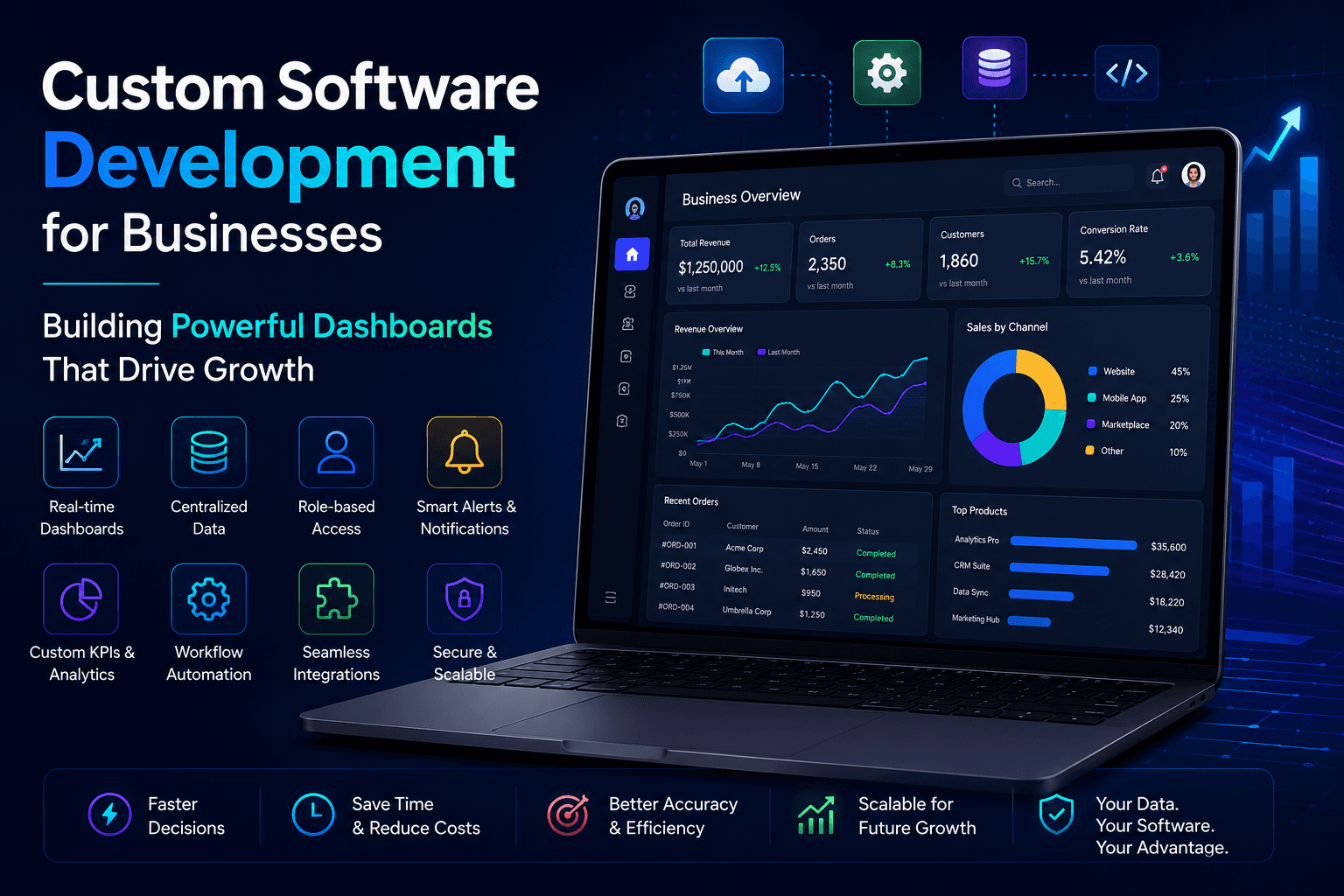
Every growing business eventually hits the same wall: spreadsheets stop scaling, off-the-shelf tools don't fit the workflow, and teams end up juggling multiple apps just to get one job done. Custom software development solves this by designing software around a business's actual processes, often centered around a real-time dashboard that pulls data from every corner of the organization into one clear view. This guide explains what custom software development involves, why business dashboards have become essential, and how the right development approach can transform how a company runs.
Learn how custom software development helps businesses replace scattered spreadsheets and generic tools with tailored dashboards, centralized data, and automated workflows built around how the business actually operates.
Introduction
Every growing business eventually hits the same wall: spreadsheets stop scaling, off-the-shelf tools don't fit the workflow, and teams end up juggling five different apps just to get one job done. Data lives in silos, decisions get delayed, and nobody has a single place to see what's actually happening across the business in real time.
Custom software development solves this problem at the root. Instead of forcing a business to adapt to a generic tool, a custom-built solution — often centered around a business dashboard — is designed around how the business actually operates. It pulls data from every corner of the organization into one clear, real-time view, and automates the repetitive work that eats up hours every week.
This guide explains what custom software development actually involves, why business dashboards have become the centerpiece of modern operations, and how choosing the right development approach can transform the way a company runs.
What is Custom Software Development?
Custom software development is the process of designing, building, and deploying software that is tailored specifically to a business's workflows, data, and goals — rather than relying on generic, one-size-fits-all products. Unlike off-the-shelf software, which forces every user into the same rigid structure, custom software is built around the actual processes a business already uses, and improves them rather than replacing them with something unfamiliar.
This can mean anything from an internal admin panel that tracks inventory in real time, to a full-scale business management system with role-based dashboards for every department. The defining feature isn't the complexity of the software — it's that every part of it exists because the business genuinely needs it, not because a vendor decided to bundle it into a package.
Why Businesses Need Custom Dashboards
A dashboard is often the single most valuable piece of any custom software project, because it's where raw data becomes an actual decision-making tool. Business leaders don't have time to dig through multiple systems to understand what's happening — they need a live, visual summary they can check in seconds.
Generic analytics tools can show generic metrics, but they can't natively track the specific KPIs that matter to a particular business — things like regional sales performance broken down by a company's own product categories, technician utilization rates for a field service company, or patient wait times for a healthcare provider. A custom dashboard is built to answer the exact questions a business's leadership actually asks, using the business's own data structure.
Key Benefits of Custom Software with Dashboards
- Real-time visibility into sales, operations, finances, and performance metrics
- Centralized data pulled from multiple tools, databases, and third-party APIs into one interface
- Role-based access, so each team or department sees only what's relevant to them
- Automated reporting, eliminating manual spreadsheet updates and end-of-week compiling
- Faster decision-making, since leadership can act on live data instead of outdated reports
- Scalability, with the software growing alongside the business instead of being replaced every few years
- Reduced operational costs, by automating manual, repetitive administrative work
- Competitive advantage, since workflows are optimized around the business rather than a generic template
- Improved data accuracy, removing errors that come from manual data entry across disconnected tools
- Ownership, since the business owns its software outright rather than paying recurring license fees for a rigid product
Core Features of a Modern Business Dashboard
A well-built dashboard is more than a collection of charts. The following features are typically what separates a genuinely useful business dashboard from a decorative one.
1. Live Data Integration
The dashboard connects directly to a business's databases, CRMs, payment systems, or third-party APIs, so the numbers on screen are always current — not a static export from last week.
2. Custom KPIs and Visualizations
Rather than generic charts, the dashboard is built around the specific metrics that matter to that business, displayed in the clearest possible format — whether that's a funnel, a heatmap, a trendline, or a simple scorecard.
3. Role-Based Views
A sales manager, a finance lead, and an operations coordinator all need different information. Custom dashboards can present tailored views for each role, so nobody wades through data that isn't relevant to their job.
4. Automated Alerts and Reporting
Instead of someone manually checking numbers every day, the system can flag anomalies, send automated summaries, or trigger notifications when a metric crosses a defined threshold.
5. Secure, Scalable Infrastructure
Business data is sensitive, and a dashboard handling it needs proper authentication, encryption, and access controls — along with an architecture that can handle growing data volume as the business scales.
The Custom Software Development Process
Building custom software isn't a single step — it's a structured process that turns a business's workflow and pain points into working software.
Skipping the discovery phase is one of the most common reasons custom software projects go wrong — a dashboard built without deeply understanding the actual workflow ends up looking impressive but solving the wrong problems.
- Discovery & Requirements Gathering — understanding current workflows, pain points, and the exact problems the software needs to solve
- Planning & Architecture — designing the data structure, system architecture, and technology stack that will support the solution long-term
- UI/UX Design — creating clean, intuitive interfaces so the dashboard is actually usable by non-technical staff, not just developers
- Development — building the frontend, backend, database, and integrations in structured, testable phases
- Testing & QA — rigorously testing functionality, performance, and security before anything goes live
- Deployment — rolling out the software to production with proper monitoring in place
- Ongoing Support & Iteration — refining features, adding new modules, and adjusting the dashboard as the business's needs evolve
Recommended Technology Stack
A modern, scalable custom software solution with a business dashboard is typically built using Next.js or React for the frontend, Node.js for backend APIs, PostgreSQL or MongoDB for data storage depending on the data structure, REST or GraphQL APIs for third-party integrations, and cloud platforms like AWS, Azure, or Google Cloud for scalable, secure hosting.
For dashboards specifically, libraries like Recharts, D3.js, or Chart.js are commonly used to build fast, responsive data visualizations, while role-based authentication is typically handled with token-based systems to ensure each user only accesses what they're authorized to see.
This stack is chosen because it balances development speed with long-term scalability — a business shouldn't need a full rebuild the moment it doubles in size.
Industries That Benefit Most from Custom Dashboards
While virtually any business can benefit from custom software, certain industries see especially strong returns. Each of these industries has workflows too specific for generic software to handle well, which is exactly where custom development delivers the most value.
- Healthcare — patient management, appointment tracking, and operational dashboards
- Logistics & Supply Chain — real-time shipment tracking and inventory dashboards
- Retail & E-commerce — sales performance, inventory levels, and customer behavior tracking
- Finance — transaction monitoring, compliance reporting, and risk dashboards
- Real Estate — property management, lead tracking, and sales pipeline dashboards
- Manufacturing — production tracking, equipment monitoring, and supply chain visibility
- Professional Services — client management, project tracking, and billing dashboards
Why Choose a Custom Software Development Company
Building software in-house requires hiring, training, and managing a full development team — a significant cost and time investment for businesses whose core focus isn't software engineering. Partnering with an experienced custom software development company instead gives a business access to a team that has already solved similar problems across multiple industries, without the overhead of building that expertise internally.
A good development partner doesn't just write code — they act as a technical consultant, helping identify which workflows are worth automating, which metrics actually belong on a dashboard, and how to build a system that won't need to be rebuilt from scratch two years later. This combination of technical execution and business understanding is what separates a genuinely useful software partner from a vendor that just delivers a checklist of features.
Conclusion
Custom software development, built around a powerful, tailored dashboard, gives businesses something off-the-shelf tools simply can't offer: software shaped around how the business actually works, not the other way around. From real-time data visibility to automated reporting and role-based access, a custom dashboard turns scattered information into a single, actionable source of truth.
As businesses continue to generate more data across more tools, the ability to centralize, visualize, and act on that information quickly is no longer a luxury — it's becoming a baseline requirement for staying competitive. Investing in custom software today means building a foundation that scales with the business, rather than one that has to be replaced the moment it's outgrown.
Problem
Businesses relying on generic, off-the-shelf software or manual spreadsheets often struggle with scattered data, disconnected tools, and delayed decision-making. Data lives in silos across different systems, manual reporting eats up hours every week, and leadership lacks a real-time view of what's actually happening across the business.
Solution
Custom software development creates tailored applications and dashboards built around a business's exact workflows and data. Instead of forcing teams to adapt to a rigid, generic tool, the software centralizes data from every system into one live dashboard, automates repetitive administrative work, and gives every department the specific view it actually needs.
Key Features
- Real-time data dashboards
- Centralized data from multiple tools and APIs
- Role-based access and views
- Automated reporting and alerts
- Custom KPI tracking and visualizations
- Secure, scalable cloud infrastructure
- Third-party system integrations
- Custom workflow automation
- Ownership of source code and data
- Ongoing support and feature iteration
Results
- Faster, data-driven decision-making
- Reduced manual reporting and admin work
- Improved data accuracy
- Lower operational costs
- Scalable software that grows with the business
- Better visibility across every department
Technologies Used
Next.jsNode.jsReactPostgreSQLMongoDBAWS
Tags
#Custom Software#Dashboards#Business Automation#Web Development#SaaS
About the Author
Written by Akash Maurya.
Published on July 9, 2026 • Updated on July 9, 2026