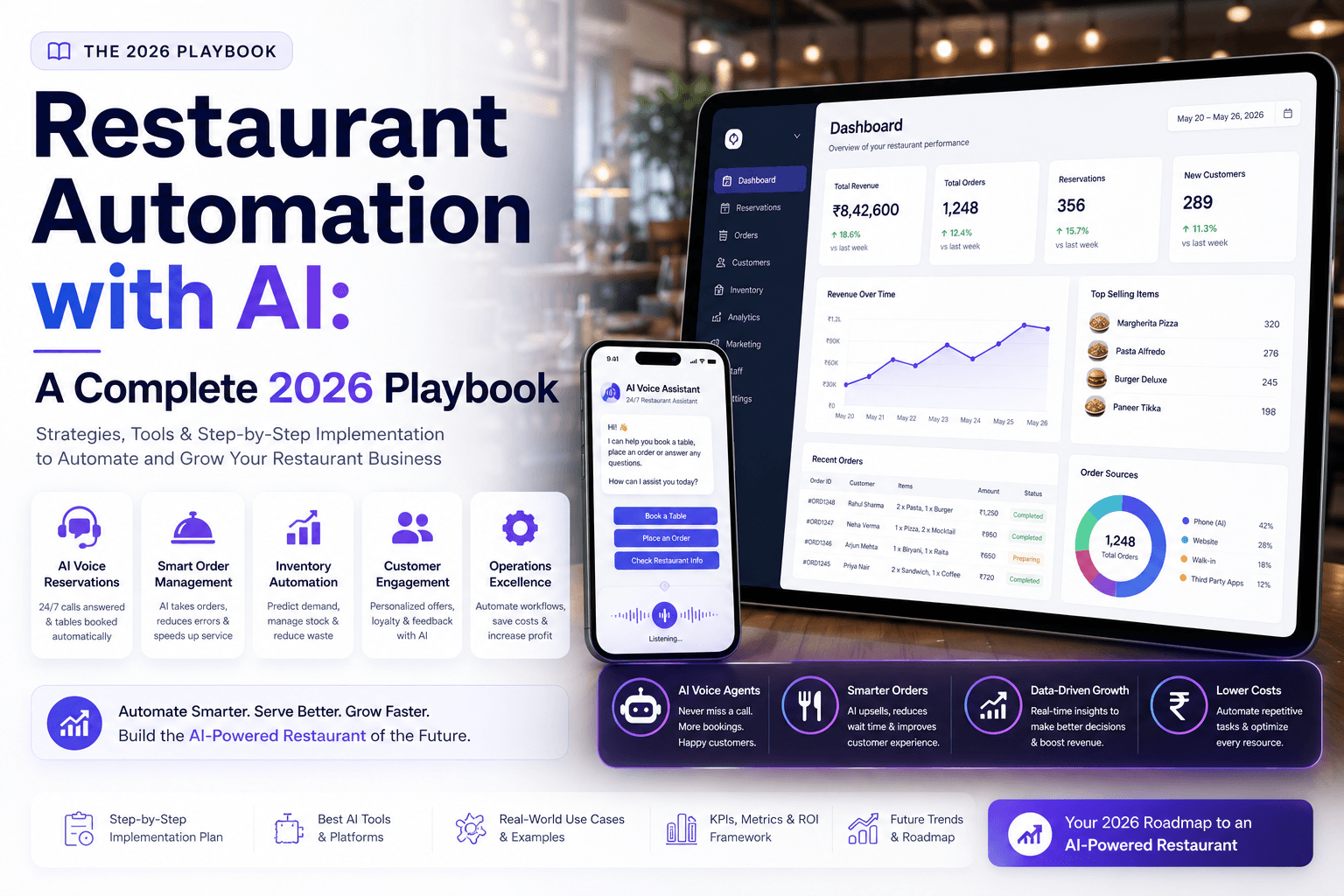
Restaurant Automation with AI: A Complete 2026 Playbook
Beyond phone calls — how AI is automating reservations, kitchen operations, inventory, staffing, and marketing for restaurants, with realistic cost and ROI numbers.
Written by
Akash Maurya
July 15, 2026
14 min read
Automation
Read article
Restaurant owners I've worked with almost always start by asking about phone automation because it's the most visible pain point, but the bigger, less obvious wins are often in inventory forecasting and labor scheduling — areas where a 5-10% improvement translates directly to margin in an industry that famously runs on 3-6% net margins. This guide covers the whole operational surface, not just the phone.
This playbook covers the full landscape of restaurant AI automation beyond just phone answering — reservation and waitlist AI, kitchen display and prep automation, demand forecasting for inventory, dynamic staffing, and AI-driven marketing — with a suggested implementation order based on ROI speed.
The Five Layers of Restaurant Automation
Restaurant AI isn't one product — it's five distinct systems that each solve a different operational bottleneck. Understanding this helps prioritize investment instead of buying whatever a vendor pitches first.
Layer
What It Solves
Typical ROI Speed
Voice/reservation AI
Missed calls, phone bottleneck at peak hours
Fast (weeks)
Demand forecasting
Over/under-ordering perishable inventory
Medium (1-2 months)
Staff scheduling AI
Over/under-staffing relative to actual demand
Medium (1-2 months)
Kitchen display automation
Ticket prioritization, prep timing
Medium-slow (2-3 months)
Marketing automation
Repeat visit rate, review management
Slow (3+ months), but compounding
Layer 1: Voice and Reservation Automation
This is usually the first and fastest win — see our dedicated guide on AI voice agents for restaurants for the full architecture. The short version: an AI agent answers every call instantly, books reservations directly into your existing system, and only escalates the calls that genuinely need a human — large parties, allergy-sensitive orders, and complaints.
Layer 2: Demand Forecasting for Inventory
Most restaurants still order inventory based on gut feel and last week's numbers. A forecasting model trained on your POS sales history, day-of-week patterns, local events, and even weather data can predict covers and dish-level demand with meaningfully better accuracy than manual ordering — directly cutting both waste (over-ordering perishables that get thrown out) and stockouts (under-ordering popular items and losing sales mid-service).
Pro Tip
Start forecasting with your three or four highest-cost perishable ingredients, not your entire inventory list — you get 80% of the waste-reduction benefit with a fraction of the setup complexity.
Layer 3: AI-Assisted Staff Scheduling
Labor is typically a restaurant's largest controllable cost, often 25-35% of revenue. AI scheduling tools combine the same demand forecast used for inventory with staff availability and skill mix to generate schedules that match staffing to predicted covers — reducing both the cost of overstaffing quiet shifts and the service failures of understaffing surprise rushes.
Layer 4: Kitchen Display and Prep Automation
AI-enhanced kitchen display systems (KDS) go beyond digitizing the ticket rail — they prioritize and batch tickets based on cook times, station load, and course timing, reducing the coordination overhead that typically falls on an expo or kitchen manager during a rush. This layer has the slowest ROI of the group because it requires kitchen workflow changes, not just software configuration.
Layer 5: AI-Driven Marketing and Reputation Management
AI tools can draft personalized responses to online reviews (positive and negative) within minutes instead of days, segment your customer base from POS data to send targeted win-back offers to lapsed regulars, and generate social content from your existing menu and photo library. This is the slowest-ROI layer but compounds over time through improved review scores and repeat visit rate.
Suggested Implementation Order
Start with voice/reservation AI — fastest, most visible ROI, lowest operational risk
Add demand forecasting for your top 3-4 highest-cost perishable ingredients
Layer in AI-assisted scheduling once you have at least 8-12 weeks of forecast data to train against
Introduce kitchen display automation only after front-of-house systems are stable
Add marketing automation last — it benefits from having clean POS and reservation data from the earlier layers
Cost Estimate for a Full Stack
A full-stack deployment for a single location typically runs $600-1,500/month combined — compare this against the labor and waste savings each layer generates; most operators see the voice and forecasting layers alone pay for the full stack within the first quarter.
Layer
Typical Monthly Cost (single location)
Voice/reservation AI
$100–250
Demand forecasting
$150–400
AI scheduling
$100–300
KDS automation
$150–350 (often bundled with POS provider)
Marketing automation
$100–250
Common Mistakes
Buying all five layers at once instead of sequencing by ROI speed and operational readiness
Skipping the data foundation — forecasting and scheduling AI are only as good as the POS data feeding them
Treating kitchen automation as a software install rather than a workflow change that needs staff buy-in
Ignoring the human escalation path in voice AI, which erodes guest trust faster than any other layer's mistakes
Not reviewing AI-drafted review responses before they're auto-posted, especially for negative reviews that need a human touch
FAQs
Where should a single-location independent restaurant start?
Voice/reservation AI, almost always — it's the fastest to deploy, requires the least operational change, and the ROI is immediately visible in recovered bookings.
Does this replace the need for a general manager?
No — it removes repetitive coordination work so the GM can focus on guest experience, staff development, and the judgment calls AI can't make.
Is this only for chains with data science teams?
No — most of these tools are now available as configured SaaS products for independent restaurants; you don't need in-house data science to benefit.
Problem
Restaurants operate on some of the thinnest margins in retail — typically 3-6% net margin — while juggling unpredictable demand, perishable inventory, high staff turnover, and razor-thin scheduling tolerances. Small inefficiencies compound: over-ordering perishables, under-staffing a surprise rush, or missing calls all directly erode an already-thin margin.
Solution
AI automation applied across the full restaurant operation — not just the phone — addresses each of these: voice agents capture every call and reservation, demand forecasting models reduce food waste and stockouts, AI-assisted scheduling matches staffing to predicted demand, and marketing automation drives repeat visits without a dedicated marketing hire.
Key Features
AI voice agent for calls, reservations, and take-out
Demand forecasting for inventory ordering
AI-assisted staff scheduling based on predicted covers
Kitchen display system (KDS) automation and prep prioritization
I build modern AI Voice Agents, SaaS platforms, automation systems, and full-stack applications that help businesses automate operations and improve customer experiences.