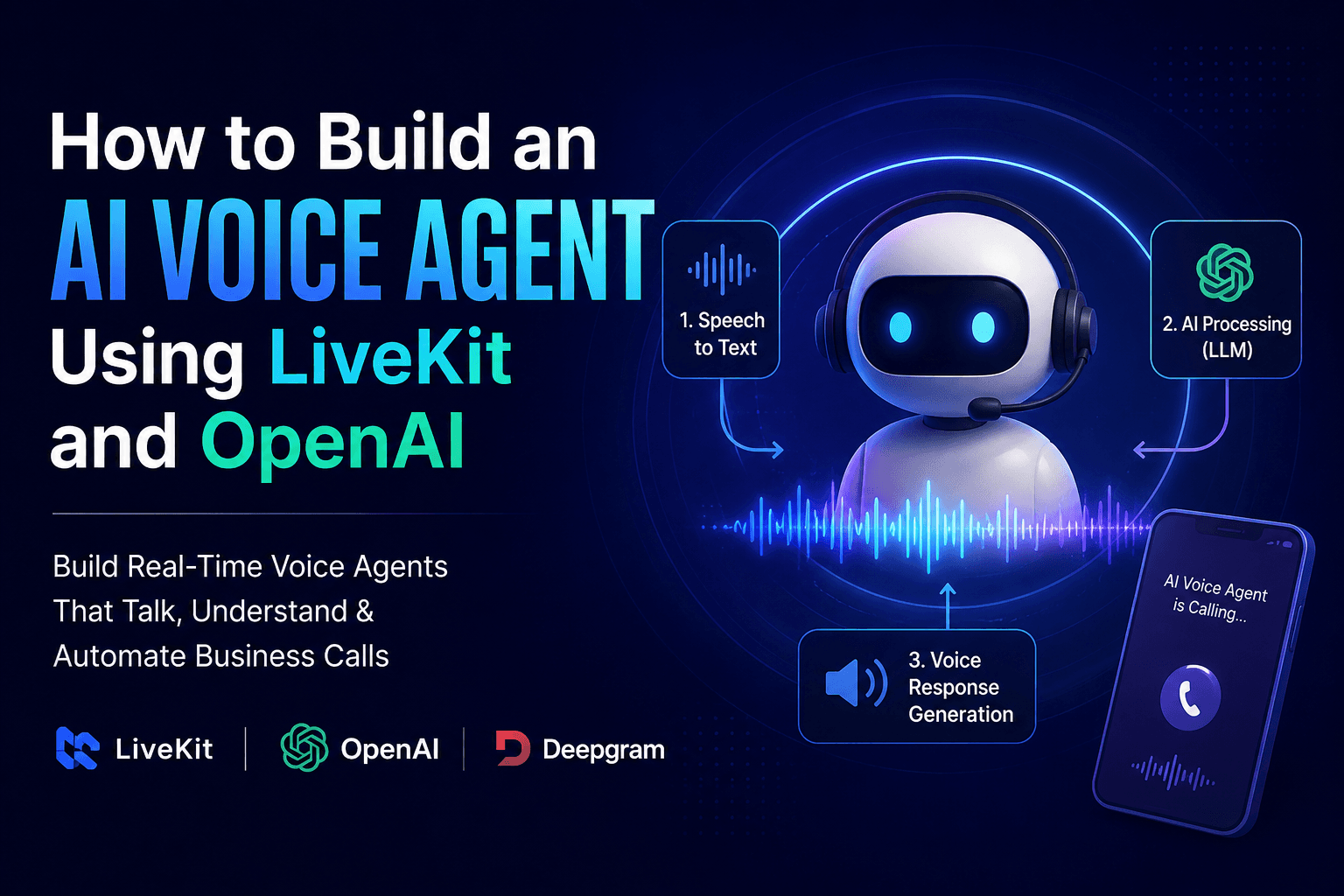
Voice AIRead Article
How to Build an AI Voice Agent Using LiveKit and OpenAI
Learn how AI voice agents automate business calls using modern AI tools.
July 2, 2026
8 min read
A hands-on comparison of Sarvam AI and ElevenLabs for voice agents — Hindi and Hinglish quality, latency, voice cloning, and real pricing in INR and USD, with a clear pick by use case instead of a forced winner.
Written by
Akash Maurya
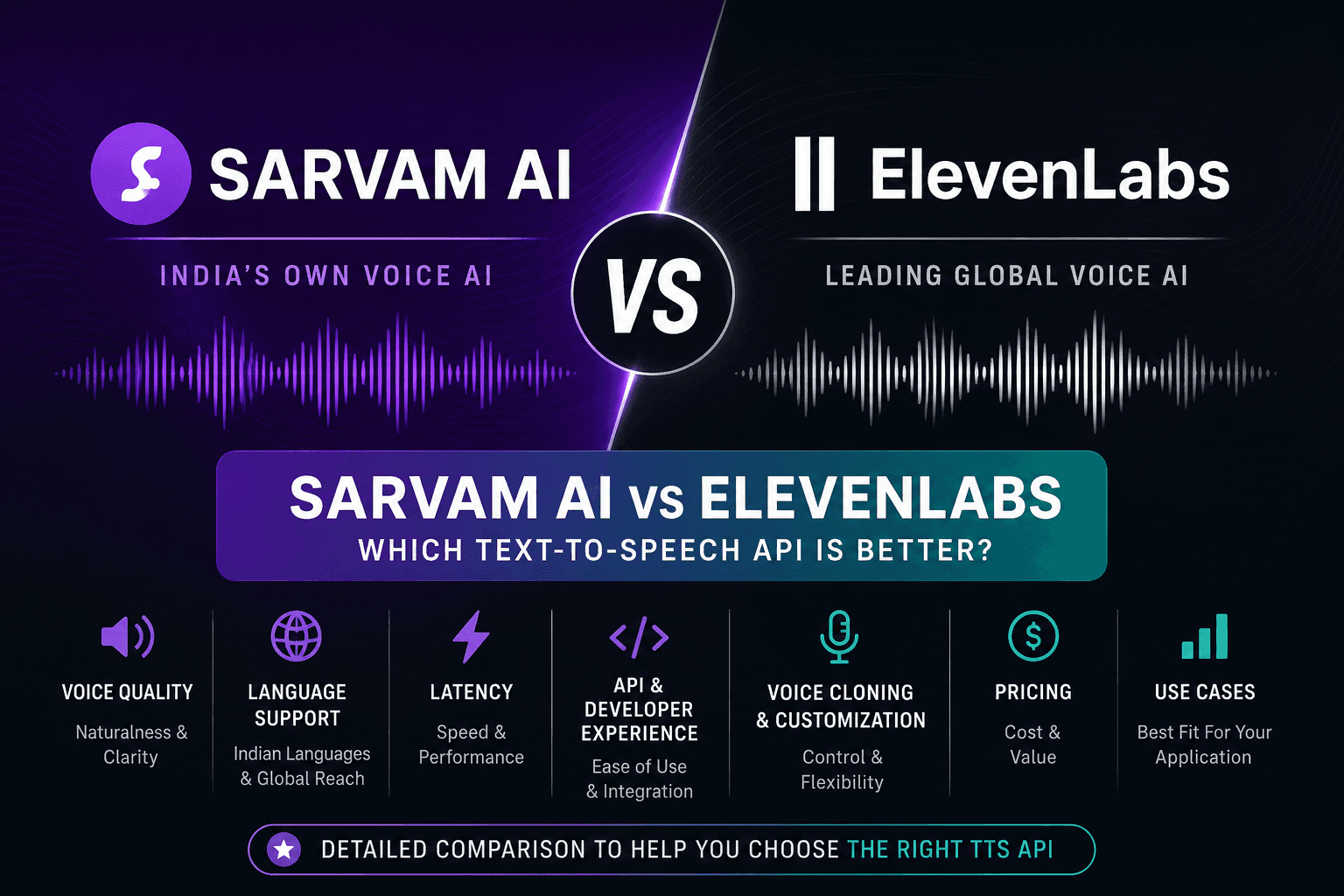
I've shipped voice agents on both Sarvam AI and ElevenLabs, for clients who needed very different things from the TTS layer — a Hindi-first appointment line for a Tier 2 clinic, and an English-first booking agent for a metro restaurant chain. The two platforms aren't really competing for the same use case, even though they show up next to each other in search results constantly. This is the comparison I wish existed before I had to figure it out by testing both myself.
A hands-on comparison of Sarvam AI and ElevenLabs for text-to-speech — Hindi and Indian-language quality, latency, voice cloning, and real pricing in both INR and USD, so you can pick the right engine for your voice agent instead of guessing from a features page.
I build AI voice agents for a living, which means this question lands in my inbox or WhatsApp almost every week: should I use Sarvam AI or ElevenLabs for text-to-speech? Usually it's a founder who's read two conflicting blog posts, or a developer who's about to wire up a LiveKit pipeline and doesn't want to redo the TTS layer three months from now.
The honest answer isn't "ElevenLabs is better" or "Sarvam is better." It's a question of who's calling. If your callers speak Hindi, or switch between Hindi and English mid-sentence the way most of India actually talks on the phone, one of these platforms is built for that and the other is adapting to it. That difference matters more than any spec sheet, and it's the reason this comparison exists — not because these are two competing logos, but because I've shipped voice agents on both and the choice genuinely changes what the caller hears.
Building for Hindi-first or Hinglish callers — customer support, appointment booking, IVR, anything where someone might say "mera order kahan hai" in the middle of an English sentence? Use Sarvam AI. It's built around code-switching, it's meaningfully cheaper at volume, and it sounds like someone who actually speaks Hindi, not a translation engine reading Hindi text out loud.
Building for English-first callers, need the widest global language range, or need a cloned brand voice that has to sound genuinely convincing? Use ElevenLabs. Its Flash and Multilingual models are still the benchmark for English voice quality and voice cloning, and nothing in Sarvam's lineup is trying to compete on that specific ground.
Building for both — a support line that gets calls in Hindi, English, and everything in between, which describes most Indian businesses I work with? Don't force a single winner. Run both, and route by detected language. It's more integration work up front, but it's the setup I actually recommend to clients, and it's what I'd build for my own product.
Sarvam's TTS model, Bulbul V3, covers 11 Indian languages with 25+ voices, and it isn't a general multilingual model that happens to include Hindi — it's trained specifically on Indian speech patterns, including the code-switching that generic TTS handles badly. A sentence like "Your appointment hai kal shaam 5 baje, please arrive 10 minutes early" — completely normal phrasing for a huge share of Indian callers — gets generated in a single pass, without the audible pause or accent shift you get when a system detects a language boundary mid-sentence and hands off between engines.
Streaming latency is sub-250ms to first byte over WebSocket, which is fast enough for a live conversational agent, and there's a text normalizer built specifically for Indian data — PIN codes, rupee amounts, ten-digit phone numbers, and Indian names, all of which trip up TTS engines trained mostly on Western data.
ElevenLabs isn't trying to compete on Indian-language depth — it's competing on breadth and raw voice quality. Flash v2.5 generates speech in roughly 75ms, about as fast as commercial TTS gets, across 32 languages. Of those 32, exactly two are Indian languages: Hindi and Tamil. If your voice agent needs Telugu, Kannada, Bengali, Marathi, or Gujarati, ElevenLabs simply doesn't have a model for it — Sarvam does.
Where ElevenLabs pulls ahead is voice cloning and English narration quality. Instant Voice Cloning is available on every paid plan, Professional Voice Cloning (the higher-fidelity option for a genuine brand voice) sits on the Scale tier and up, and for straight English speech, the Multilingual v2 and newer v3 models are still what most developers benchmark against.
Here's how the two actually stack up once you get past the marketing pages:
| Category | Sarvam AI (Bulbul V3) | ElevenLabs (Flash / Multilingual) |
|---|---|---|
| Indian languages | 11 languages, 25+ voices | Hindi and Tamil only, out of 32 total |
| Code-switching (Hinglish etc.) | Native, single-pass generation | Not designed for this — switches at language boundaries |
| Global language range | India-focused; not built for this | 32 languages (Flash v2.5), strong global coverage |
| Latency | Sub-250ms to first byte (streaming) | ~75ms generation (Flash v2.5) |
| Voice cloning | Available, not the primary strength | Instant + Professional cloning, widely considered best-in-class |
| Pricing model | INR, pay-as-you-go, ~₹15–30 per 10,000 characters | USD, tiered plans + PAYG, ~$0.05–0.10 per 1,000 characters |
| Free tier | ₹1,000 in free credits | Free plan, ~10,000 characters/month |
| Best fit | Hindi/Hinglish-heavy Indian voice agents | English-first products, global apps, branded voice cloning |
At a moderate voice agent volume — say 100,000 characters of TTS output a month, roughly what a single-location business generates on steady call volume — Sarvam runs somewhere around ₹150–300 (under $4) on pay-as-you-go pricing. On ElevenLabs, that volume fits inside the $5–6/month Starter API plan if you're using Flash or Turbo, which includes about 120,000 Flash characters, or you'd need the $22/month Creator plan for Multilingual v2 quality at that volume.
Scale past a few hundred thousand characters a month and the gap widens fast, mostly because Sarvam's per-character rate doesn't really change with volume the way ElevenLabs' plan tiers do. Run your own expected monthly character count through both before deciding — the entry-level sticker price on either platform isn't what you'll actually pay at production volume.
On paper, ElevenLabs' 75ms generation time beats Sarvam's sub-250ms streaming latency by a wide margin. In practice, for a phone-based voice agent, both are well inside the range where a caller perceives the response as immediate — human conversational turn-taking has natural gaps in the 200–500ms range anyway, and once you add network round-trip and telephony overhead on top of either number, the practical difference shrinks a lot.
Where it matters more is consistency. Sarvam's streaming latency is what you get across all 11 of its languages, while ElevenLabs' fastest number is specific to Flash v2.5 — its higher-quality Multilingual models trade some of that speed for better prosody.
This is where most comparisons cop out and tell you "it depends on your needs" without saying what that actually means. Here's how I'd map it to real businesses:
If you're building this yourself: the cleanest pattern is to detect language from the caller's speech-to-text output, or ask upfront — "Hindi ya English?" — and store the preference, then route the TTS call accordingly, using Sarvam for Hindi/regional segments and ElevenLabs for English segments. Both expose a standard streaming API, so neither is hard to wire into a LiveKit or Twilio Media Streams pipeline.
The extra complexity is real — you're maintaining two API keys, two billing dashboards, and two voice identities that need to feel like the same "agent" to the caller — but for a business that genuinely serves both language groups, it beats forcing every caller through a TTS engine that wasn't built for their language.
Pro Tip
If you're short on integration time, start with one engine for the whole product and add the second only once you have real call data showing a meaningful share of Hindi/regional-language callers. Don't build a dual pipeline on day one for a caller base that might turn out to be 90% English anyway.
For Hindi, and especially Hinglish (mixed Hindi-English), yes — Sarvam's Bulbul V3 is trained specifically on Indian speech patterns and handles code-switching natively, while ElevenLabs applies patterns built across its 32 supported languages generally, with Hindi as one of them rather than a specialization.
ElevenLabs' Flash v2.5 and Multilingual models support Hindi and Tamil specifically, out of 32 total languages. They don't cover Telugu, Kannada, Bengali, Marathi, Gujarati, Malayalam, Punjabi, or Odia — languages Sarvam supports natively.
At comparable character volumes, Sarvam AI is usually the cheaper option. Its pay-as-you-go pricing runs roughly ₹15–30 per 10,000 characters, while ElevenLabs' published API rates are about $0.05 per 1,000 characters on Flash/Turbo and $0.10 per 1,000 on Multilingual v2/v3, plus a monthly plan minimum starting around $5–6. Run your own expected volume through both before deciding — the gap changes depending on which ElevenLabs model you need.
Yes, and for businesses serving both Hindi/regional and English-first callers, I usually recommend exactly that — route to Sarvam for Hindi/regional-language segments and ElevenLabs for English, based on detected language or caller preference, rather than forcing one engine to handle everything.
ElevenLabs. Voice cloning is one of its core strengths — Instant Voice Cloning is available on paid plans and Professional Voice Cloning on higher tiers — and it isn't the focus of Sarvam's product, even though Bulbul V3 does include a cloning feature.
Most "Sarvam vs ElevenLabs" content online is generic feature-list filler — the kind that lists both platforms' bullet points side by side without ever actually testing either one, or telling you which to pick for a real voice agent handling Indian callers.
A direct, tested comparison covering the dimensions that actually decide this for a voice agent — Hindi and Hinglish quality, latency under real conditions, voice cloning, and cost at real character volumes — ending in a clear recommendation by use case instead of a forced single winner.
Written by Akash Maurya.
Published on August 23, 2026 • Updated on August 23, 2026
Learn how AI voice agents automate business calls using modern AI tools.
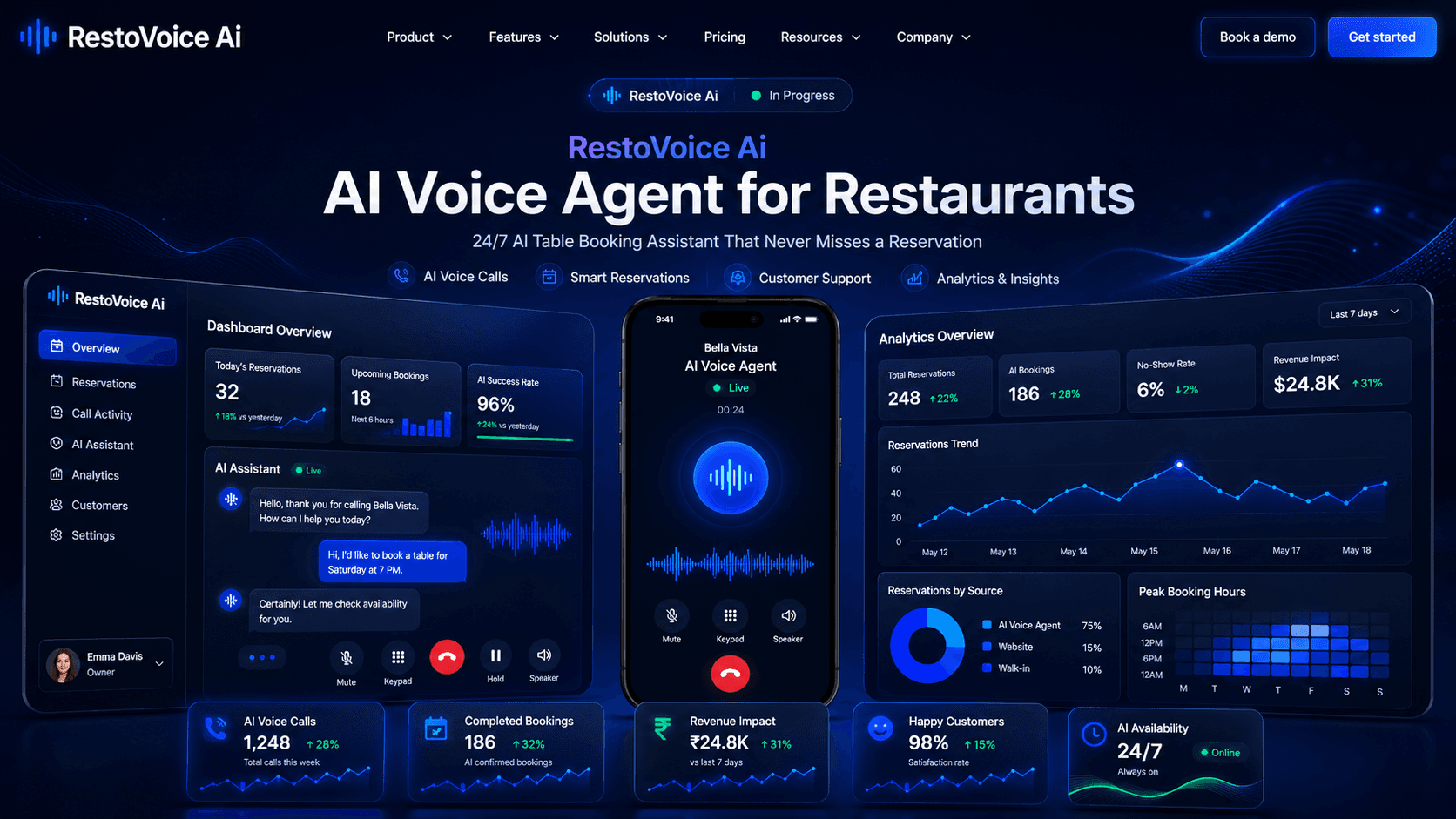
A senior engineer's field guide to deploying AI phone agents that take reservations, answer menu questions, and stop restaurants from losing money on missed calls.
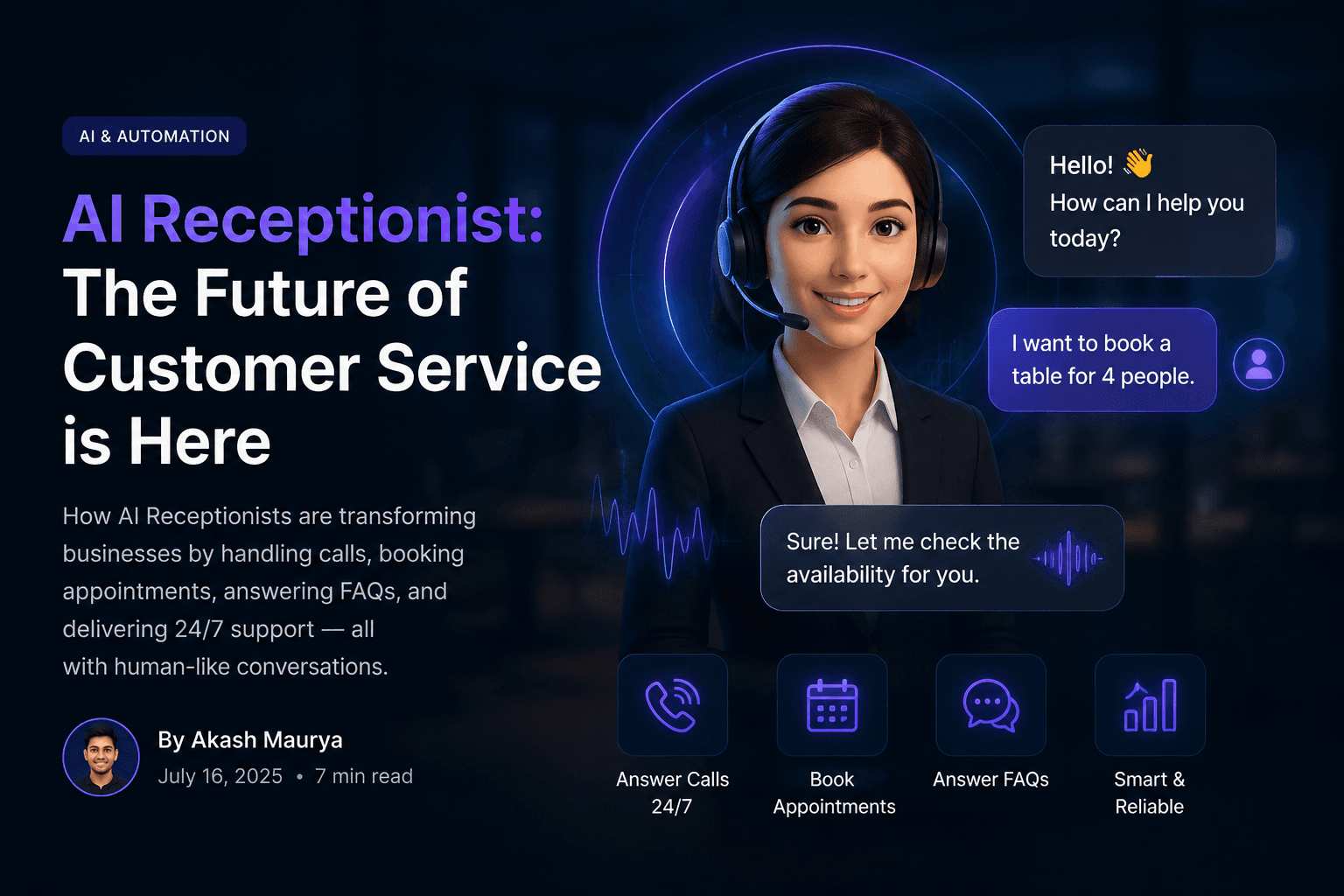
A practical look at how AI receptionists work, where they genuinely outperform humans, where they don't, and how to deploy one without breaking the guest or customer experience.
I build modern AI Voice Agents, SaaS platforms, automation systems, and full-stack applications that help businesses automate operations and improve customer experiences.